Charcoal cobble, clay brick and granite can all make a good Cape Town driveway. But they are three different materials, and none of them rescues a driveway built on a poor base.
Where we stand: we lay driveway paving in cobble, clay brick and granite, so this is a paving business’s view, not lab data. Our sources are industry bodies for each material: the CMA and the Concrete Society for cobble, and the Clay Brick Association for clay; none covers granite. There are no prices here, because what moves the price of a driveway is the site as much as the paver.
The short version
- Charcoal cobble is a concrete block coloured with pigment. Most concrete blocks are chamfered, which the CMA says improves how they perform and look [3].
- Clay brick is fired clay with its own SANS standard. Depending on the class, the edges may be chamfered or square [4].
- Granite setts are natural stone. In our view, expect colour to vary between batches and see stone from your batch before you order.
- Block strength matters less than interlock. The CMA puts the structural performance of concrete block paving down to interlock, provided the blocks are above a minimum strength [1].
- The base decides more than the paver. Get the base, bedding and edge details written on the quote.
What is actually different about the three?
What they are made of, where the colour comes from and how the edges are shaped. How they are laid matters more than any of those.
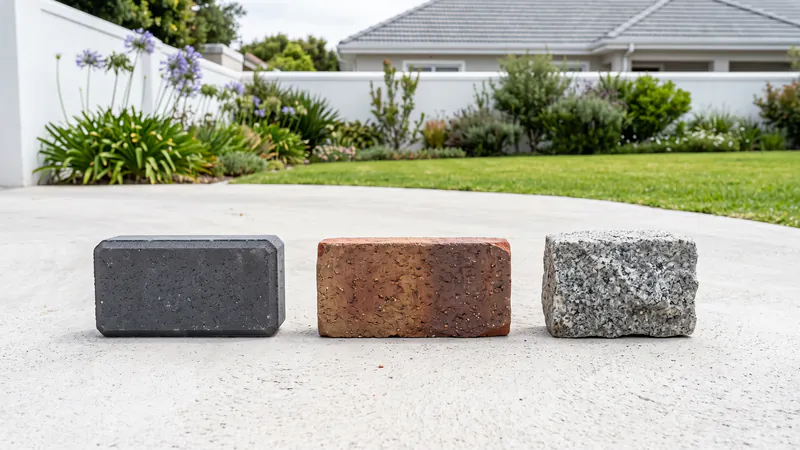
| Charcoal cobble | Clay brick | Granite setts | |
|---|---|---|---|
| Colour | Pigment in the concrete [2] | The clay and the firing (our view) | The stone itself |
| Edges | Most are chamfered [3] | Chamfered or square, by class [4] | Depends on the cut or split |
| Product standard | SANS 1058 [2] | A separate SANS clay paving standard [4] | Neither of those |
Charcoal cobble: a pigmented concrete block
A moulded concrete block with pigment in the mix. Most concrete blocks have chamfered edges.
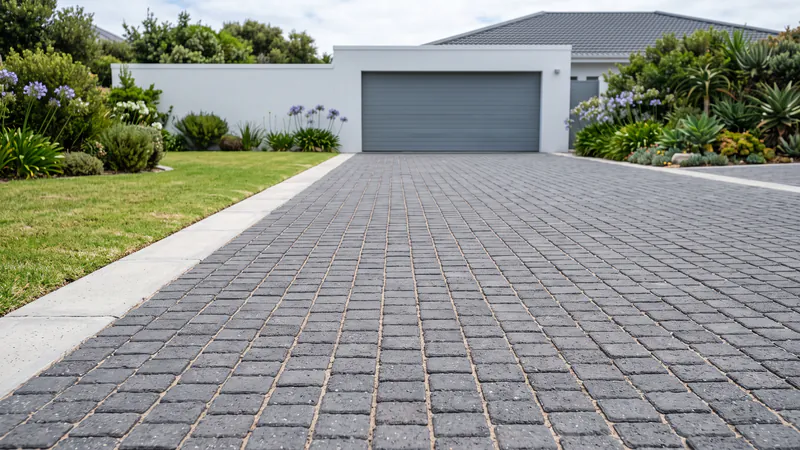
The Concrete Society’s leaflet on making paving blocks puts the pigment dose at “generally 5%, but not more than 10%, by mass of the cement” [2].
Good
- The CMA lists black, brown, red and tan as the basic pigment colours [1]
- Most have chamfered edges, which the CMA says improve performance and appearance [3]
- 50–60mm blocks are generally adequate for domestic use [3]
- A settled area can be lifted, fixed and re-laid [3]: what happens when paving sinks and has to come up
Watch out for
- Colour can vary, so the CMA advises the buyer to keep agreed reference samples of the colour range [1]
- An early whitish bloom (efflorescence) is, per the CMA, mostly temporary and does not affect strength [3]
- Smoother blocks look better, rougher ones give better skid resistance [1]
On strength: the Concrete Society’s 2024 leaflet says SANS 1058 classes blocks by tensile splitting strength: 2.0 MPa average for Class 30/2.0, 2.6 MPa for Class 40/2.6 [2]. The “Class 25 blocks should be specified for most uses” line in the CMA’s Book 3 belongs to the older SANS 1058-1985 compressive classes, with exceptions for wheel loads over 30 kN, a scheduled Class 35, and exceptional loads or severe conditions [1]. Ask for SANS 1058 compliance, and whether your loads call for a higher class.
Clay brick: fired clay with its own standard
A fired clay paver with its own SANS standard. Choose it for the look, then check the edge profile of the range.
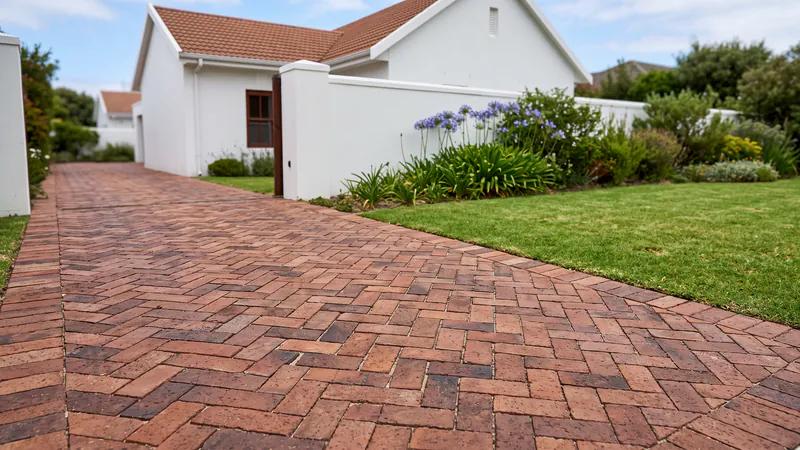
The Clay Brick Association’s paving guide defines clay pavers as “fired clay units intended to form the surface course of a pavement” [4]. It describes two classes: Class PA units “may have chamfered arrises”, while Class PB units have edges “that are not chamfered” [4].
Good
- In our view, warm tones that suit traditional houses
- Herringbone is the guide’s preferred pattern where vehicles drive [4]
- Guidance for laying on a sand bed or on a concrete slab [4]
Watch out for
- On a slab-laid pavement, the guide says a bevelled or rounded edge can disguise height differences, so check the class [4]
- Light-coloured clays can show vanadium stains, “neither permanent nor harmful” per the guide [4]
- Ask whether it goes on sand or on a slab with mortar joints: the guide treats them as different pavement types [4]
Granite setts: natural stone
Natural stone, chosen for its look. None of our sources covers it, so judge it on the supplier’s data and a sample from your batch.
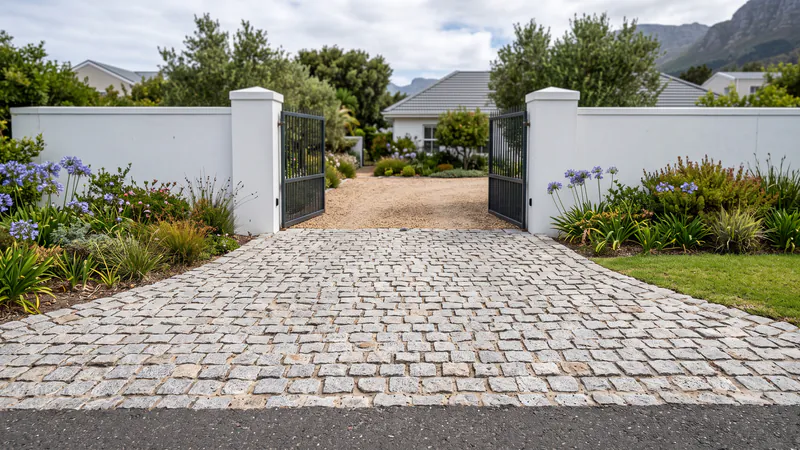
SANS 1058 covers concrete paving blocks and the Clay Brick Association’s guide covers clay [2][4], so for granite the supplier’s data is your reference.
Good
- Colour is the stone’s own, with no pigment
- A split or flamed face usually gives texture rather than a smooth finish
- In our view, setts laid on a sand bed can be lifted and re-laid, as block paving can
Watch out for
- In our view, stone usually varies between batches, so keep spare setts for repairs
- In our view, split setts are less uniform than moulded blocks, so expect wider joints
- Ask for the stone’s data sheet and tested wet slip rating
Does the house or setting change the answer?
In our view, mostly through the architecture. We have no test data showing that any of the three handles sea air, wind or sun better than the others.
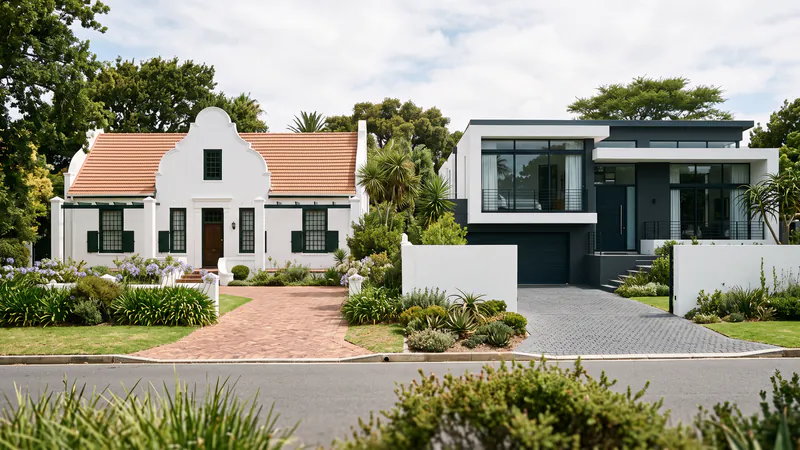
Our design view:
- Traditional and gabled houses: clay brick sits well with white walls and terracotta roofs.
- Contemporary houses: charcoal cobble suits dark window frames and grey or charcoal render.
- Formal entrances: granite setts work as an apron at the gate.
- Near the sea: ask the supplier, in writing, what the specific range is rated for.
In Constantia, for instance, we quote all three finishes; the house decides between them, not the suburb. If the driveway is part of a bigger job, the patios, paths and pool surrounds we also pave can go on the same quote.
The base matters more than the paver
The CMA puts a block pavement’s structural performance down to interlock, provided the blocks are strong enough. Interlock comes from how the paving is laid.
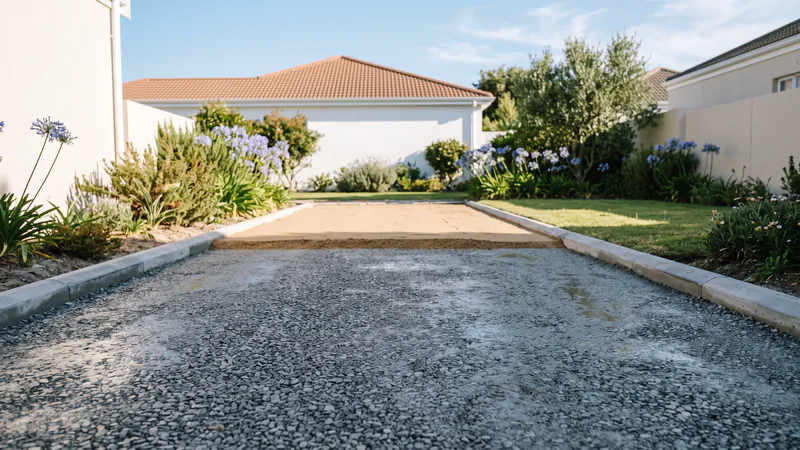
In the CMA’s words, structural performance “is dependent on the degree of interlock, which spreads the load and is virtually independent of the strength of paving blocks, provided it is above a certain minimum level” [1].
- Subgrade and sub-base: Book 3, written for civil-engineering contracts, builds new ones to SANS 1200 DM and ME [1]. Ask who is responsible for the layers under the sand.
- Bedding sand: for concrete blocks, 25mm ±10mm after compaction [3]; the clay guide specifies 30mm [4]. Never a levelling course for voids in the sub-base, which “will lead to subsequent settlement” [3].
- Jointing sand: a finer sand; “the same sand should not be used in both cases” [3].
- Edge restraints: “All cbp must have an edge restraint” (cbp is concrete block paving), which may be cast in situ, precast or an existing structure [3].
- Water: “Most failures of pavements are due to ingress of water into the pavement layerwork” [3].
Get these as lines on the quote, and know what to inspect on the finished driveway before you pay. That, not the paver, is why the same paver holds up on one driveway and not the next.
So which paver suits your driveway?
Our view, as a paving business: choose the look that suits the house, then put the care into the base.
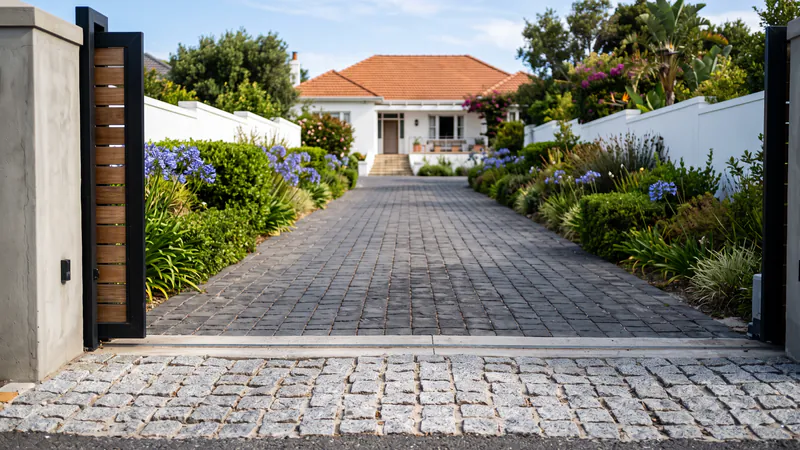
Charcoal cobble
Our pick for a contemporary house
Pigmented concrete covered by SANS 1058. Keep a colour reference sample.
Clay brick
Our pick for a traditional house
Fired clay with its own classes. Check whether the range is chamfered or square-edged.
Granite setts
Our pick for a formal entrance
Natural stone, not covered by SANS 1058 or the clay standard. Judge a sample from your batch and keep spares.
Still deciding whether to pave at all? Here is how paving compares with tar and cast concrete.
Common Questions
Are clay bricks better than concrete pavers?
Neither is simply better. Clay pavers are fired clay with their own SANS standard, and concrete blocks are pigmented concrete under SANS 1058, so compare specific ranges on their data sheets. Choose the look, then compare quotes on the same base and edging.
Is granite paving worth it?
That depends on the look you want and your quote. We don’t publish prices, so ask for granite and an alternative priced on the same base and edging, or granite for just the gate apron.
Which paver is best for a steep driveway?
The laying matters more than the material. The Clay Brick Association says shunting and edge chipping on sloping sites are common to concrete, clay and reconstituted stone pavers, and for sloping clay driveways it recommends 45° herringbone and plain concrete transverse beams across longer sloping drives (the guide gives about 5m in one section and about 7m in another) [4]. Ask how the slope and drainage will be handled.
Do concrete pavers fade in the sun?
Coloured concrete pavers take their colour from pigment, and the SANS 1200 MJ clauses reproduced in the CMA’s Book 3 required that colour to reach at least 5mm below the wearing surface [1]; that depth is about wear, not sunlight. A whitish bloom in the early months can be efflorescence, which the CMA says is mostly temporary [3]. We don’t publish fade rates; ask the manufacturer about the range you are buying.
Are paving bricks slippery when wet?
It depends on the product and its surface, not just the material name. For concrete blocks, the CMA notes that rougher blocks give better skid resistance than smoother ones [1]. Ask for the tested wet rating of the exact range, the same advice we give for checking slip ratings around a pool.
Can I mix two paver types?
Yes. A field in one material with a contrasting border course frames a driveway, and a granite gate apron is another combination. Ask for each material priced as its own line.
Weighing up cobble, clay and granite for your own driveway? We do free on-site assessments across Cape Town: we look at the site and follow with a written quote, with no obligation to use us for the work. See how we build up a written quote, or call 021 825 6396, weekdays 8am to 5pm.
Sources
- Concrete Manufacturers Association — Concrete Block Paving, Book 3: Specification and Installation (§3.1.1 colour; §3.1.2 class, strength and type, with commentary and the SANS 1058-1985 extract; §5.1.1.1 subgrade and subbase). cma.org.za (PDF)
- Concrete Society of Southern Africa — The manufacture of concrete paving blocks (2024), §2.2 and Table 1 (SANS 1058 classes); §3.3 Pigments. concretesocietysa.org.za (PDF)
- Concrete Manufacturers Association — Concrete Block Paving, Book 2: Design Aspects (§2.3 bedding sand; §2.4 blocks, chamfer and thickness; §2.5 jointing sand; §2.6 edge restraints; §2.7 drainage; §6 maintenance). cma.org.za (PDF)
- Clay Brick Association — Clay Paving Guide: A Technical Handbook (2016, with Think Brick Australia): Part Two definitions; Part Three specifying clay pavers; §4.3 sloping driveways; Part Five rigid pavements; §6.3.4 vanadium stains. claybrick.org (PDF)