What does paving cost in Cape Town? No per-square-metre figure can be true for your driveway before someone has looked at the ground under it, so we don’t publish one. What we can show you is what drives the price: the lines a paving quote is made of, and what moves each of them.
Where we stand: we quote and lay paved driveways, patios and pool decks across Cape Town. The build-up detail below comes from the Concrete Manufacturers Association (CMA), the precast concrete producers’ body writing about its own product, so we quote its guidance and say where the view is ours.
The short version
- No per-square-metre figure. The cost depends on the site, so we price a job after measuring it.
- The paver is one line of several. Excavation, base, bedding and jointing sand, cutting, drainage and edge restraints are priced too.
- The base is the part you can’t see later. The CMA says bedding sand should not be used to fill hollows in the base, because that “will lead to subsequent settlement” [1].
- Shape, slope and access move the number. Two driveways of the same area can be very different jobs.
- Compare quotes line by line. A quote that names the base, paver, joint sand and edge restraint can be checked; a single rate can’t.
What’s actually in the price?
A paving price bundles several separate lines: taking out what is there, the base, the bedding sand, the pavers, the laying and cutting, the joints and the edge restraint. Ask for each on its own line.
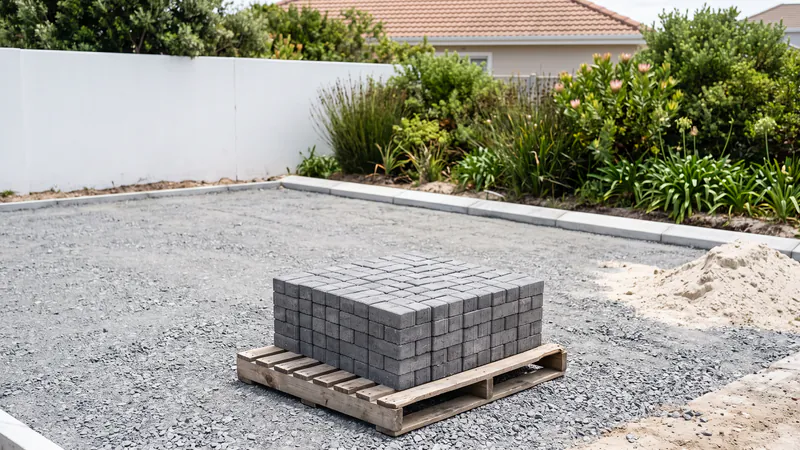
- Excavation and removal: digging down to the level the base needs, and carting away what comes out.
- Sub-base: the compacted layer that carries the load.
- Bedding sand: a thin layer, 25mm ±10mm after compaction, usually of coarse river sand [1].
- Pavers: the product, colour and thickness. Book 2 says thicker blocks resist deformation better, but “there is a cost implication and thickness selection should be based on application” [1].
- Laying, cutting and compaction: Book 3 names guillotine block cutters or power saws for the cuts, and at least two compactor passes before the joints are filled [2].
- Jointing sand: a different, finer sand from the bedding: Book 2 says “the same sand should not be used in both cases” [1].
- Edge restraints: Book 2 says “All cbp must have an edge restraint” [1], and Book 3 lists cost among the factors in choosing which design to use [2].
What moves the number on your site
What is already there, how much base has to be built, the drainage and the edges. Most of it doesn’t show in a photograph, so we measure up before we quote.
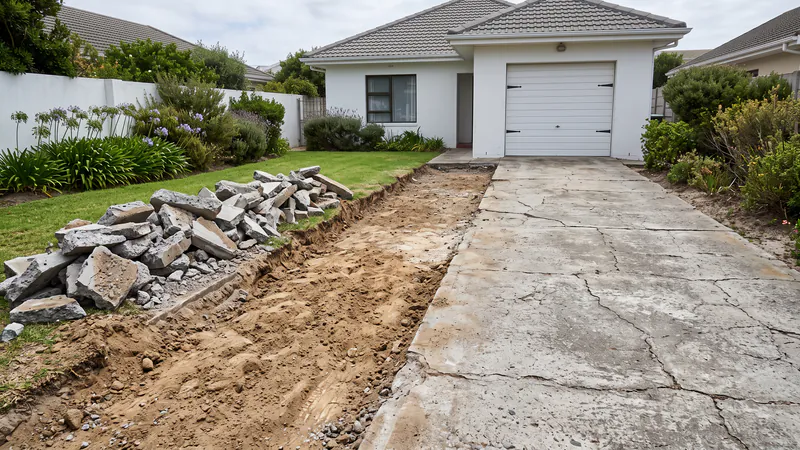
- The old surface: breaking out and carting away old concrete is a job in its own right.
- Base preparation: how much has to come out and be rebuilt. In our view that is set by your ground and what drives over it, not by a default depth.
- Drainage: Book 2 says a minimum fall of 2% in any direction is generally required, with paving laid 5 to 10mm proud of stormwater structures or channels [1].
- Edges and levels: restraints, and tying in to thresholds, kerbs and manholes. Book 3 says a separate restraint is unnecessary where the paving joins an existing concrete pavement, or asphalt at least 100mm thick [2].
- Trees: a root barrier, or a layout that allows for a mature tree beside the paving. Ask an arborist before roots are cut.
Water is why the hidden lines matter: Book 2 says “Most failures of pavements are due to ingress of water into the pavement layerwork” [1]. If your property has its own stormwater drains, the City’s by-law also makes you keep them working, “at own cost” [3].
Shape, slope and access: same size, different job
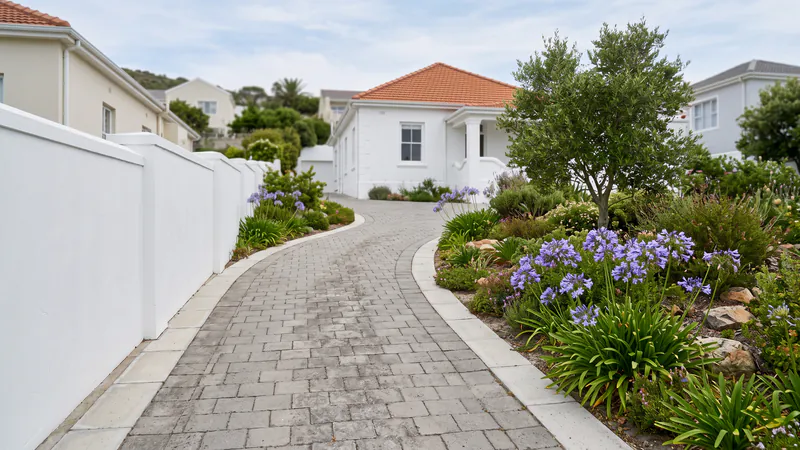
Two driveways with the same area can be priced differently. Curves and narrow strips add cutting, a steep slope adds design details, and poor access means everything moves by hand.
Keeps the job simpler
- One open, square area with few cuts
- A machine and a tipper can reach the work
- A gentle fall the ground already gives
- An old surface that lifts easily
Adds work
- Curves, corners and narrow strips to cut
- A steep slope that may need anchor beams and drainage details [1]
- Barrow-only access through a side gate
- A concrete slab to break out first
Cutting: Book 3 does not recommend cut pieces smaller than about 25% of a full paver, because “these small units can be dislodged under traffic” [2]. Our guide to how layouts change the cutting covers curves, borders and bonds.
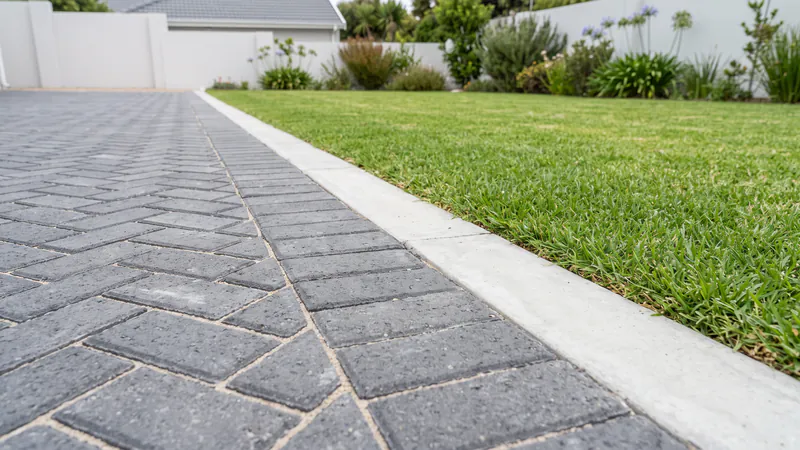
Bond: Book 2 says the herringbone pattern “ensures the best resistance to both horizontal and vertical deformation” [1]; in our view that matters most where cars turn. Steep slopes are covered in the questions below.
Driveways, patios and pool surrounds price differently
The build-up can differ too: porcelain and large-format stone need a concrete base. The material and the detailing around it change as well. Which costs more on your property depends on what you choose and on the site.
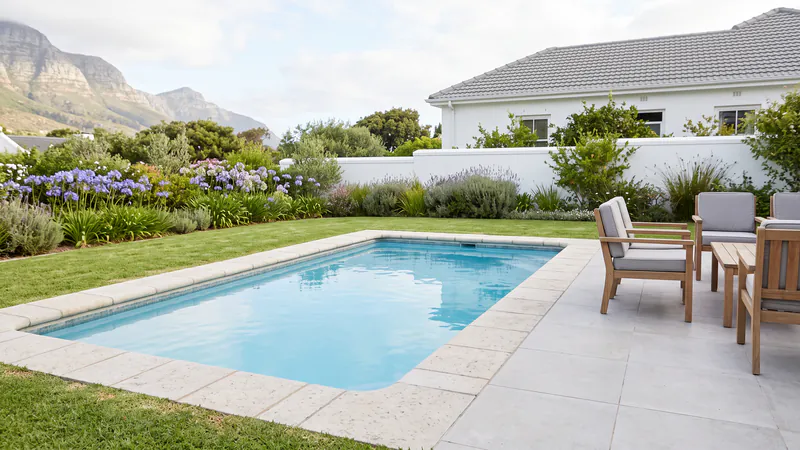
- Driveways carry cars, so the base and the edges do the heavy work. Book 2 says “Generally for domestic use, 50 – 60 mm blocks are adequate” [1].
- A patio around a braai area opens up more materials, from clay brick and concrete cobble to natural stone and porcelain. In our view, that makes the material choice a bigger part of the price.
- Pool decks add coping at the water’s edge, and grip matters: ask for the tested wet slip rating of the exact product you are quoted, in writing.
We quote every job as paving contractors in Cape Town the same way, line by line, even where the build-up differs. Our pool surround comparison weighs up travertine, slate and porcelain, and the paver comparison does the same for driveways.
Why cheap quotes can cost more
In our view, a quote far below the others is usually pricing less work somewhere, and the easiest place to save is the base and edges nobody sees after handover. If that base fails, the repair means paying for it again.
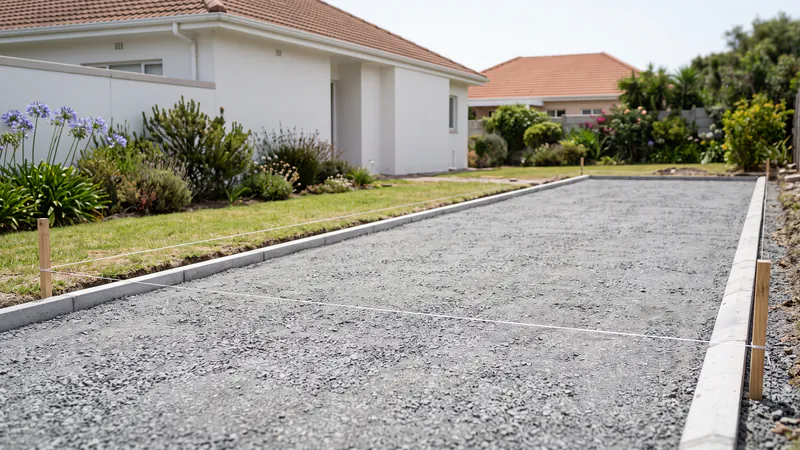
Where a paviour lays the paving only, Book 3’s commentary puts “the strength and the line and level of the layerworks” on the main contractor [2]. On a home job the paving contractor may be the only one on site, so ask who builds the base and to what standard.
A thinner base is not the only shortcut. Book 2 says the bedding layer “should not be used as a levelling course to fill voids in the subbase surface. This will lead to subsequent settlement” [1].
When a base does fail, the fix is not a top-up. Book 2’s remedy for settlement is that the area is lifted, “the problem addressed, the level reinstated and the pavers re-laid” [1], so the excavation and base get paid for a second time. Our guide to fixing paving that has sunk walks through it.
What to check on any paving quote
A quote that names the base, the paver, the joint sand and the edge restraint can be compared with another that does. One number on one line can’t.
Run this over any paving quote. Afterwards, use our checks for spotting bad paving work before you pay.
Ask for these in writing
- Excavation and base: the sub-base material, depth and compaction standard, and who builds it. In our view, a written quote that names no base material or depth is a warning sign.
- Edge restraint: the type, and every edge it runs along.
- The paver, named exactly: the product name, colour and thickness, and, for concrete pavers, the SANS 1058 class the supplier states for it.
- Joint sand: a fine jointing sand, not the coarse bedding sand. Book 2 says “Coarse river sand is ideal for bedding, while a finer plaster sand is necessary for jointing” [1].
- A polymeric joint product, if quoted: Book 2 mentions specialised polymers only for sealing airport joints [1], so ask for the product’s data sheet and follow it.
- Spoil removal: whether carting away what is dug out is in the price.
- Warranty and insurance: any workmanship warranty in writing with its duration, and proof of public liability cover.
Common Questions
How much per square metre is paving in Cape Town?
We don’t publish a figure, because the rate depends on the paver you choose, how much base has to be built under it, the access, the slope and the drainage. The only figure worth anything comes from someone who has measured your site.
Why won't you publish a price list?
We have not found a South African trade body, standard or government source that publishes paving rates, and a list can’t see the ground and access at your property, which is where much of the cost sits.
Why are some paving quotes a fraction of the others?
In our view, a quote far below the rest is pricing less work, and the buried base and edges are the easiest parts to thin. Ask every quote to name the sub-base, edge restraint, paver and joint sand, then compare line by line.
Can I save money by sourcing pavers myself?
Possibly on the materials line, but the excavation, base, edges and laying still have to be priced. If you supply the pavers, get the product, thickness and, for concrete pavers, the SANS 1058 class in writing, and agree who answers for a faulty paver as opposed to faulty laying.
Does paving cost more on a steep driveway?
It can. The design factors Book 2 lists for steep slopes include an anchor beam at the bottom of the pavement and at intervals depending on the length and gradient, plus attention to draining the bedding sand at the lower end [1]. How much that adds depends on your slope, so we price it after seeing it.
Is permeable paving worth the extra cost in Cape Town?
We don’t publish a rate or a percentage for it. The CMA calls full infiltration “a particularly economic solution” because it needs no pipes or gulleys, while its systems for ground that can’t take all the water add outlet pipes or a membrane [4], so in our view the difference sits in the build-up your ground needs. Ask for both builds priced side by side. Our guide explains how permeable paving drains and when it suits, including what the City’s stormwater rules do and don’t require.
Want a real number for your site? We do free on-site assessments across the Peninsula: we measure up and follow with a written quote, with no obligation to use us for the work. See how we build up a written quote, or call 021 825 6396, weekdays 8am to 5pm.
Sources
- Concrete Manufacturers Association — Concrete Block Paving, Book 2: Design Aspects (bedding sand, sec 2.3; block thickness and laying patterns, sec 2.4; jointing sand, sec 2.5; edge restraints, sec 2.6; drainage, sec 2.7; steep slopes, sec 5.1; airports, sec 5.4; settlement, sec 6.4). cma.org.za (PDF)
- Concrete Manufacturers Association — Concrete Block Paving, Book 3: Specification and Installation (subgrade and subbase, sec 5.1.1.1; edge restraints, sec 5.2; cutting, sec 5.5; compaction, sec 5.6; joint filling, sec 5.7). cma.org.za (PDF)
- City of Cape Town — Stormwater Management By-law, 2005 (s8(1): owner responsibility for private stormwater systems on the property). openbylaws.org.za
- Concrete Manufacturers Association — An Introduction to Permeable Concrete Block Paving (2010; systems A, B and C). cma.org.za (PDF)