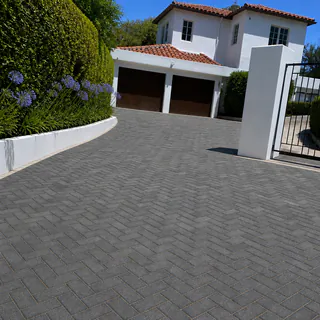
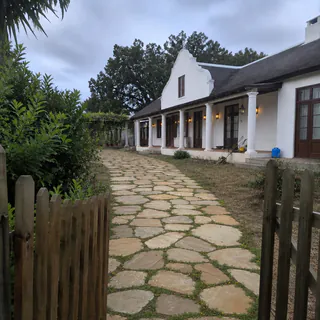
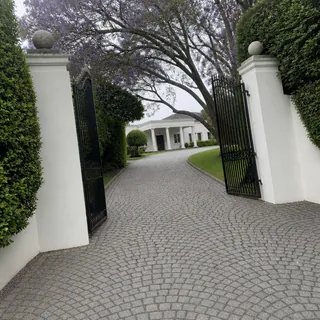
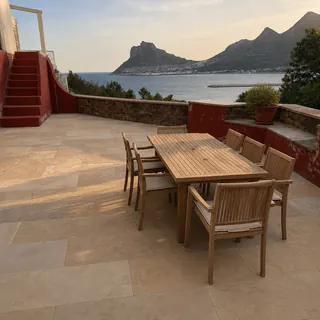
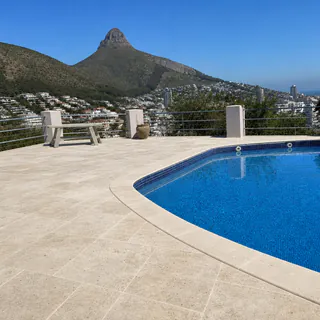
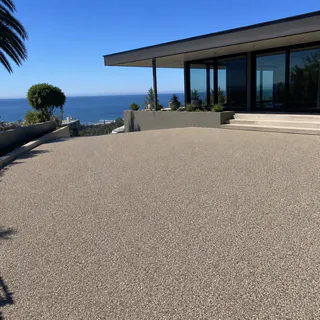
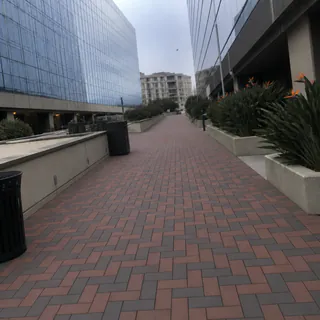
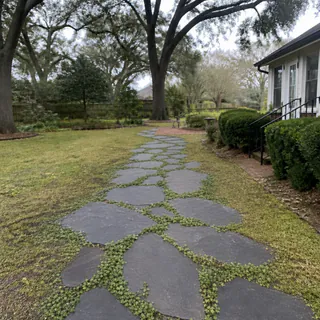
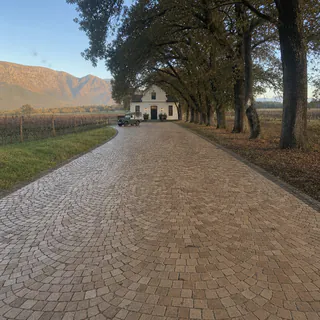
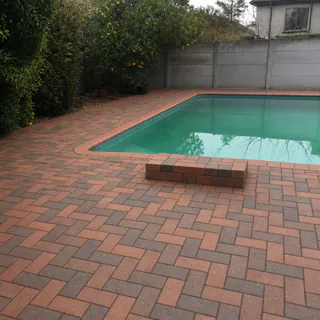
A paved driveway is only as good as the layers under it. We lay driveway paving across Cape Town in charcoal cobble, clay brick, exposed aggregate and granite, and we build every one on a base designed for the ground and the traffic it carries.
We come out, measure up and check the ground and the fall, then put a written, itemised quote together with the excavation, base, paver and edging each on its own line. Free, with no obligation.
The short version
- The base does the work. The Concrete Manufacturers Association (CMA) puts most pavement failures down to water getting into the layers under the paving.
- Edges on every side. CMA Book 2: "All cbp must have an edge restraint." (cbp is concrete block paving.)
- A thin sand bed. Bedding sand screeded to 25mm after compaction, 10mm either way, and never used to fill hollows in the base.
- Herringbone where cars drive. The CMA says it gives the best resistance to horizontal and vertical deformation.
- No rate card. You get a written price after we have measured your driveway.
When It's Time For A New Driveway
Cracks, sinking and weeds are symptoms. What matters is the cause, whether that is the joints, the edges or the layers underneath, and that is what we check at the measure-up.
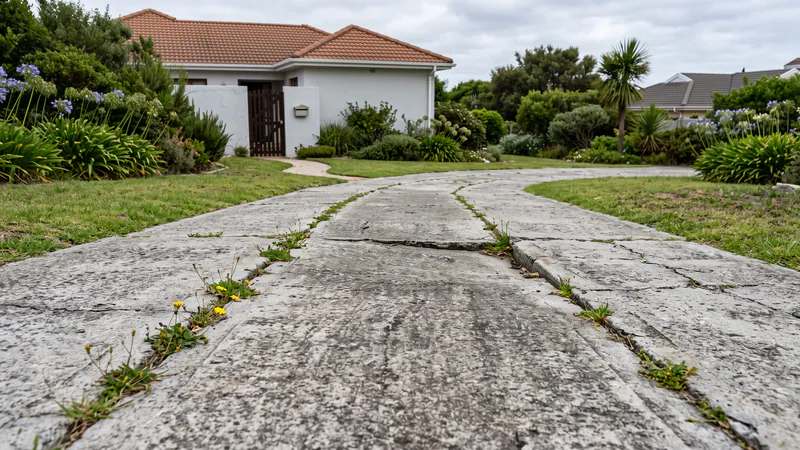
Cracked or sunken concrete
A concrete slab cracks at random if it was not laid in jointed panels, and it can crack where the ground under it settled unevenly. The Concrete Society of Southern Africa calls for firm, stable ground and joints every 2.5 to 3m. The cracks alone don't tell you which, and that decides whether you need a new driveway.
Weeds through every joint
The CMA puts most weed growth in large paved areas down to wind-blown seeds germinating in the jointing sand, so weeds that keep coming back point to joints that need attention. We re-joint, or relay where the paving has lost its interlock.
Oil stains on an old surface
The CMA says concrete block paving itself is not affected by oil, so a stain is a looks problem rather than a structural one. If the surface is past cleaning, relaying it is an option, and we will tell you honestly which applies.
Paving lifted by tree roots
Roots can lift sections of paving off the base. Get the tree looked at by an arborist first; the affected area can then have a lift-and-relay of just that section rather than a whole new driveway.
Built On A Proper Base, Not Just Sand
When block paving settles, the CMA lists the causes as an inadequate subbase or subgrade, water under the pavement, overloading, or a bedding layer that is too thick. Your quote spells out the excavation, base, bedding and edges in writing.
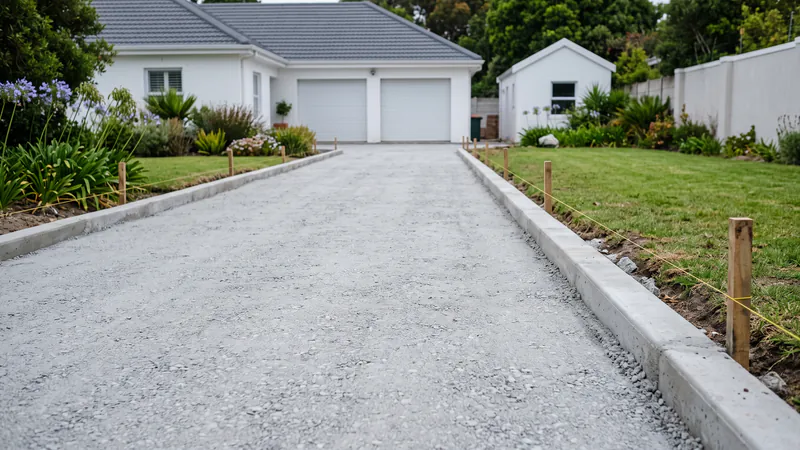
- Excavation: down to ground worth building on, with the old surface carted away.
- Base: G5 base material laid and compacted in layers.
- Bedding sand: screeded to 25mm after compaction, with a 10mm tolerance either way, as the CMA publishes.
- No sand in the hollows: CMA Book 3 says "Bedding sand shall not, under any circumstances, be used for this purpose" — filling dips in the base.
- Edge restraints: on every open edge, because "All cbp must have an edge restraint" (the CMA accepts an existing structure as the restraint).
The CMA's Concrete Block Paving books are free to download, so you can check the bedding depth and edge restraints on your quote against them. Our guide explains why the layers under a driveway matter most.
Choosing The Paver
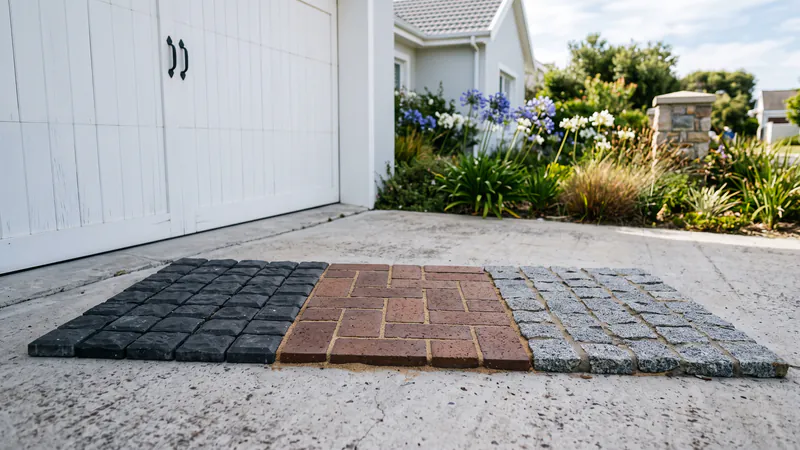
Choose the look that suits your house, then get the product, thickness and class written on the quote.
Charcoal cobble
A pigmented concrete block. Most concrete blocks are chamfered, which the CMA says improves how they perform and look.
Clay brick
Fired clay with its own SANS paving standard. Depending on the class, the edges may be chamfered or square.
Granite
Natural stone, not covered by the concrete or clay paving standards, so judge a sample from your batch.
Exposed aggregate
A finish with the stone showing at the surface. Ask whether you are being quoted pavers or cast concrete, and for the product's data sheet.
For domestic use the CMA says 50–60mm concrete blocks are generally adequate. We compare the first three side by side in our charcoal, clay and granite paver guide, and borders, bonds and grass strips change the look as much as the paver does.
Pavers We Lay
What Installation Looks Like
Five stages, and the ones that decide how the driveway wears happen before any pavers go down.
Free on-site measure-up
We measure the area, check the ground and the fall, and put a written, itemised quote in your hands. No call-out fee for the measure-up.
Break-out & sub-base
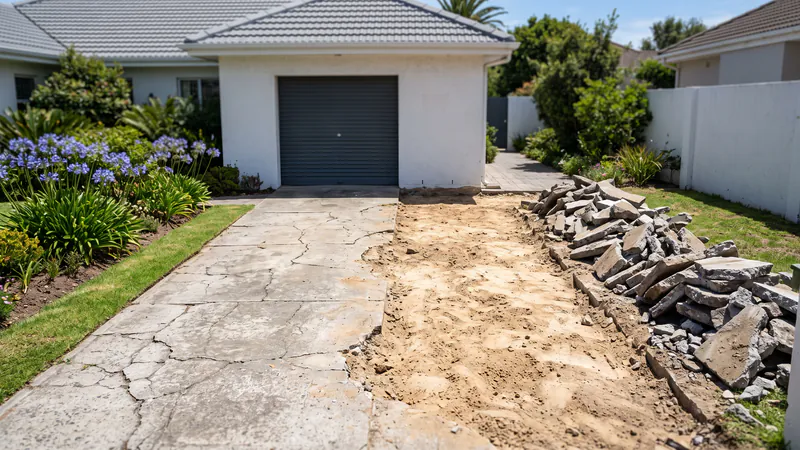
The old surface comes up and is carted away, then G5 base material is laid and compacted in layers down to ground that will carry the load.
Edge restraints & bedding
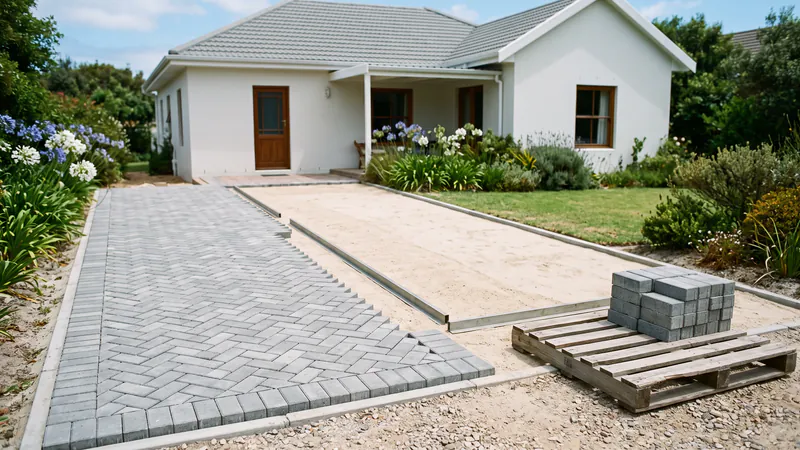
Edge restraints go in along every open edge, then the bedding sand is screeded to 25mm compacted.
Pavers laid & cut to fit
The paving goes down in the pattern you chose. Edges and obstacles are cut with a power saw or a block cutter so the lines stay clean.
Compaction, jointing & clean-up
A plate compactor locks the paving, fine jointing sand (finer than the bedding sand, as the CMA specifies) is brushed in, and we walk the site with you. The CMA recommends topping joints up when required, typically about three months after laying.
Want a free driveway paving quote?
We measure up on site and put a written, itemised price in front of you. No call-out fee, no pressure.
What Driveway Paving Costs In Cape Town
We don't publish a per-square-metre rate. Four things move the price, and your quote puts each one on its own line.
The paver
Plain concrete cobble sits at the lower end, clay brick in the middle, and granite at the top.
Excavation and base
How deep we have to dig before we reach ground worth building on, and how much base goes back in.
Break-out
How much old concrete or paving has to come out and be carted away.
Slope and access
A steep driveway can need anchor beams and drainage details, and tight access means more work by hand.
A number quoted off a photograph is one you can't hold us to, so we measure first. For everything else that goes into a quote, see our line-by-line breakdown of a paving price.