Polymeric sand, plaster sand, “paving sand”, a bag of cement mixed in: ask around and you will hear all four for the gaps between paving blocks. They behave very differently once the rain arrives, and the wrong one shows up as washed-out joints or cracked, stained grout.
Where we stand: we arrange paving and the re-sanding and repair work that follows it, so this guide sticks to what the published specifications say. Most of it comes from the Concrete Manufacturers Association (CMA), the concrete producers’ own industry body, plus one polymeric sand maker’s own product page. Where the view is ours, we say so.
The short version
- The CMA’s default is a fine plaster sand, brushed in dry and vibrated until the joints stay full [1][2][3].
- Not the bedding sand. The CMA says the same sand should not be used for both [1].
- No cement across the paving. The CMA says it leads to cracking and water getting in [1].
- Polymeric sand sets in the joint; the one product we checked is limited by its maker to joints under 5mm wide and at least 30mm deep [4].
- Stabilise only where sand washes out: steep slopes, downpipes and eaves with no gutters, per the CMA’s step-by-step guide [3].
What the CMA says should go in a paving joint
A fine plaster sand with a little clay or silt in it, spread dry and vibrated into the joints until they stay full.
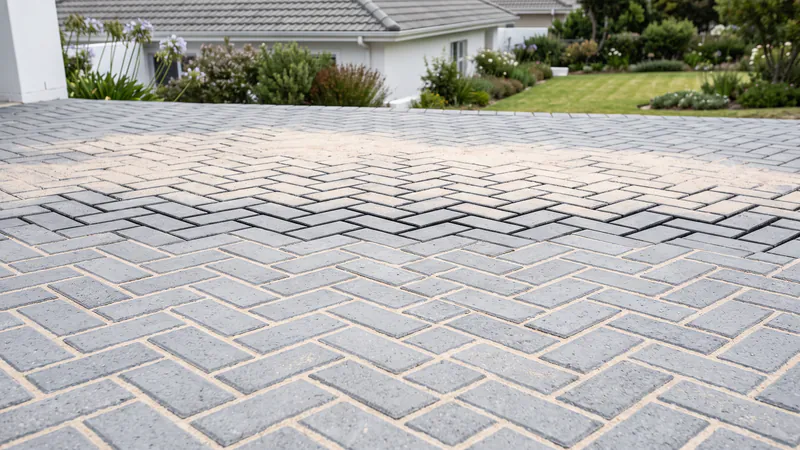
The joints do structural work. Book 3 says “Fully filled joints are essential for the achievement of the full structural performance of the pavement” [2]. What goes in them is written down:
- Grading: jointing sand “shall pass a 1,18 mm sieve and shall contain 10- 50% of material that passes a 0,075 mm sieve” [2].
- A little clay: Book 2 says the sand “should ideally contain a little clay or silt. This helps seal the joints against water ingress” [1].
- In plain terms: the step-by-step guide says “Use fine plaster sand, 100% dry” [3].
- Joint width: Book 3 sets 2mm to 6mm, and calls 3mm the optimum, though hard to achieve consistently [2].
Permeable paving works differently: its wider joints are filled with stone, not sand, so this guide is about ordinary block paving.
Why the joints need a different sand from the bedding
Bedding wants coarse river sand that stays non-plastic; joints want a finer sand with a little clay that packs in and seals.
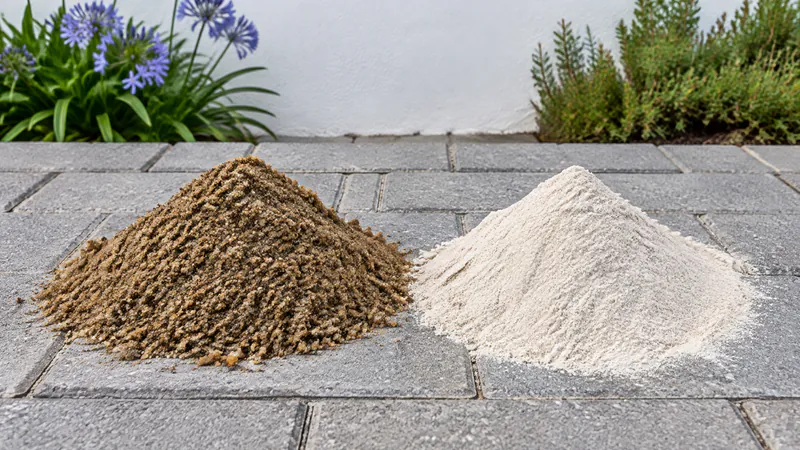
Book 2 is blunt: “Coarse river sand is ideal for bedding, while a finer plaster sand is necessary for jointing between the paving blocks” [1]. It adds that “the same sand should not be used in both” layers [1].
| Bedding layer | Joints | |
|---|---|---|
| Sand | Well-graded washed river sand [3] | Fine plaster sand [1][3] |
| Clay | Should be non-plastic [2] | A slight percentage is ideal for sealing [2] |
| Moisture | About 6 to 7% [3] | 100% dry [3] |
| How much | 2.5m³ per 100m² of paving [3] | About 10% of the bedding sand order [3] |
Polymeric sand: what it is, and what one maker says it needs
It is jointing sand with a binder in it. The product we checked sets when wetted and suits narrow, deep joints where sand keeps washing out, on its own data sheet’s terms.
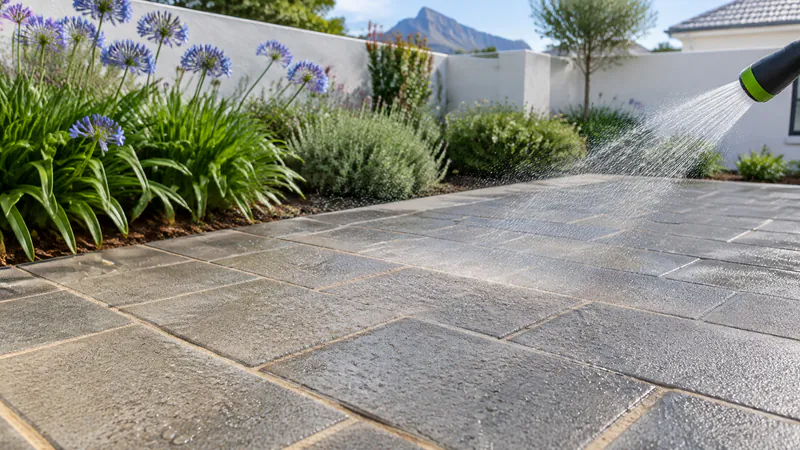
The maker of ROMEX NP, a polymeric jointing sand sold in South Africa, describes it as “a self-hardening sand with bonding agents that is activated when it comes into contact with water” [4]. Its page is clear about where it fits:
Good
- Contains “natural binding agents and polymers but NO CEMENT” [4].
- Pitched for “steep driveways and paving under gutter/down pipes”, where sand loss is common [4].
- Sets in the joint, where plain sand relies on its particles locking together [4].
Watch out for
- Narrow joints only: under 5mm wide and at least 30mm deep [4]. The CMA allows joints up to 6mm [2], so a 5 to 6mm joint is in spec for the CMA and out of range for this product.
- No pressure washer: the maker says it “is not resistant to high-pressure cleaners” [4].
- Not in the CMA’s guides: none of the three names polymeric sand; Book 2 mentions polymers only for sealing airport joints in the UK [1].
Other polymeric products carry their own limits, so read the data sheet for the exact bag on site, not this one.
Cement in the joints, and where the CMA’s own guides disagree
Both CMA documents keep cement out of the joints across the paving; they part ways only at downpipes and other wet spots.
Book 2 says cement “should not be added to the jointing sand as this will lead to cracking and subsequent water ingress” [1]. It turns the paving “into a more rigid pavement” that cannot take movement “without distress”, and cement “tends to discolour the paving and is difficult to remove afterwards” [1]. The step-by-step guide puts it in capitals: “NEVER add cement to bedding or jointing sand” [3].
The split is at the wet spots. Book 2 recommends “a little cement” right by a downpipe or stormwater outlet, about 10% by mass [1]. The 2016 step-by-step guide is newer than Book 2’s 2004 edition. It says to stabilise jointing sand only “On steep slopes (>1 in 20)”, around downpipes and along roof overhangs with no gutters. It names “bentonite or proprietary sealers” for the job and adds “Don’t use cement” [3].
In our view the newer guide is the safer reading, and the better fix is sending roof water to a drain in the first place, which our patio guide’s section on roof water covers.
How the joints should be filled, and when to top them up
Fill only after the blocks are compacted, keep everything dry, vibrate until the joints stay full, then top up in the first months.
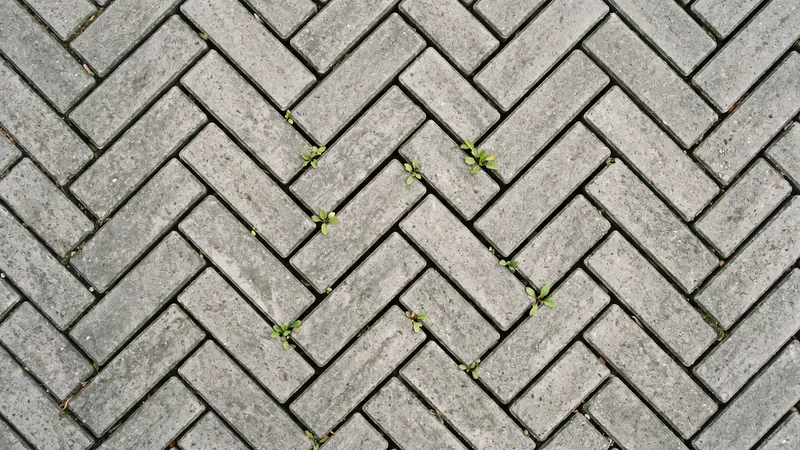
- Wait for the blocks. Book 3: no filling until closure units are in, line and level are adjusted and the paving has had “at least two passes of the compactor” [2].
- Dry sand, dry blocks. Damp sand “may bridge across them and resist compaction without this being obvious at the surface” [2].
- Brush, never hose. “The sand should be brushed and not washed into the joints” [2].
- Repeat until full. Broom and compact again “until the joints remain full after compaction” [2].
- Top up. Book 2 says typically three months after construction [1]; the step-by-step guide says resand within the first six months and again after heavy rain washes sand out [3].
Book 2 also advises “all paving contracts to include a clause on resanding” [1]. Joint checks sit in our sign-off checklist for a new paving job. On older paving, a pressure washer empties joints too, which our paving cleaning guide covers. If the blocks have dipped or rock underfoot, sand will not fix it; in our view a sunken section needs lifting and relaying.
So which should go in your joints?
Our view, as a paving business: plain fine plaster sand for most of the job, stabilised only where water concentrates, and never cement.
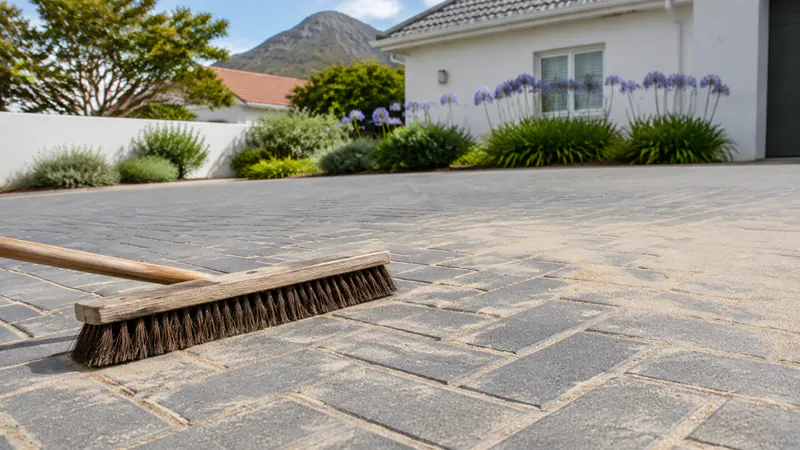
Fine plaster sand
Best for most driveways, patios and paths
It is what the CMA specifies. Brush it in dry, vibrate it and plan for a top-up.
Stabilised joints
Best for slopes, downpipes and eaves
Only in the spots the step-by-step guide names, with bentonite or a proprietary sealer, not cement.
Polymeric sand
Best if your joints fit its data sheet
Check joint width and depth first, and follow that product’s instructions, not a general rule.
The joints are the last layer of the job, on top of the bedding, the base and the edges. For the rest of the work, see the paving jobs Paving Cape Town arranges.
Common Questions
What type of sand is best for paving?
It depends on the layer. The CMA calls for coarse river sand under the blocks and a finer plaster sand in the joints, and says the same sand should not be used for both. Jointing sand should pass a 1,18mm sieve.
Does polymeric sand get hard like cement?
It sets when wetted, but one maker says its product contains no cement and allows the pavers some movement. Cement in joints is what the CMA warns against, because it makes the paving rigid and leads to cracking.
What are the disadvantages of polymeric sand?
It only works within its data sheet. One product is limited to joints under 5mm wide and at least 30mm deep, and its maker says it is not resistant to high-pressure cleaners.
What is a cheaper alternative to polymeric sand?
The CMA’s own specification needs no polymeric product: plain fine plaster sand, brushed in dry. We publish no product prices. Where sand keeps washing out, the CMA’s step-by-step guide suggests bentonite or a proprietary sealer in those spots, never cement.
Does paver sand harden like concrete?
Plain jointing sand does not, and that is by design. The CMA describes block paving as a flexible pavement, and says cemented joints turn it into a rigid one that cracks.
Joints washing out, or not sure what is in yours? We arrange free on-site assessments across Cape Town and follow up with a written quote, with no obligation to use us for the work. See how a paving job is priced, or call 021 825 6396, weekdays 8am to 5pm.
Sources
- Concrete Manufacturers Association — Concrete Block Paving, Book 2: Design Aspects (4th ed., 2004): §2.5 jointing sand; §5.4 airports; §6.1 jointing sand maintenance. cma.org.za (PDF)
- Concrete Manufacturers Association — Concrete Block Paving, Book 3: Specification and Installation (5th ed., 2009): §3.3 sand for bedding and jointing, with commentary; §5.4 joint widths; §5.7 joint filling, with commentary. cma.org.za (PDF)
- Concrete Manufacturers Association — A step-by-step guide to perfect paving (2016): Step 1.4 ordering bedding and jointing sand; Step 7 placing and stabilising jointing sand. specifile.co.za (PDF)
- ROMEX — ROMEX NP Jointing Sand, the maker’s product page: description and FAQs 1, 7, 9 and 10 (read 21 November 2026). romex.co.za